Frequently Asked Questions
Have questions? We are here to help.


You have $500 extra this month. Do you put it in a savings account, buy stocks or Exchange-Traded Funds (ETFs), or throw it at your credit card debt? Many Canadians freeze at that question, and in 2026, the stakes are higher than they look. Canadian household credit market debt has surpassed $3.2 trillion, credit card interest rates still sit between 19% and 22%, and consumer insolvencies hit a 16-year high in 2025.
At the same time, something has quietly shifted for people with cash to put to work. The Bank of Canada has held its overnight rate at 2.25%, inflation has cooled to 1.8%, and savings accounts and GICs are finally paying real returns again. That impacts the math on where your next dollar should go.
Neither saving nor investing is a one-size-fits-all answer, and for many Canadians, neither is the right starting point. Building a financial foundation, especially clearing high-interest debt, must come first. This guide walks through how saving and investing work, how they compare, and how to tell which one (if either) makes the most sense for your situation.
Saving means setting money aside in a safe, easy-to-access place where the goal is to keep it intact, not grow it. You're trading returns for certainty.
Savings rest on two ideas: capital preservation (your money stays safe from market swings) and liquidity (you can reach the money quickly, usually within a day, without penalties). That makes savings the right place for cash you might need on short notice, such as an emergency fund or a near-term down payment.
Two savings vehicles do most of the work in Canada:
Both are covered by deposit insurance through the Canada Deposit Insurance Corporation (CDIC), a federal agency that protects eligible deposits at member institutions up to $100,000 per category, including those held in a Tax Free Savings Account (TFSA), Registered Retirement Savings Plan (RRSP), or First Home Savings Account (FHSA). For more on building a savings habit, see our guide on how to save money.
The biggest advantage of saving is protection. You know what you'll have in six months, and you can access it quickly. The trade-off is purchasing power: if your account pays 1.5% and inflation runs at 1.8%, prices rise faster than your savings grow. While the dollar figure in your account looks the same (or slightly higher), what that money can actually buy gets smaller every year.
Investing means putting money into assets designed to grow over time, such as stocks, bonds, ETFs, or mutual funds. Your principal isn't guaranteed, but potential returns are higher.
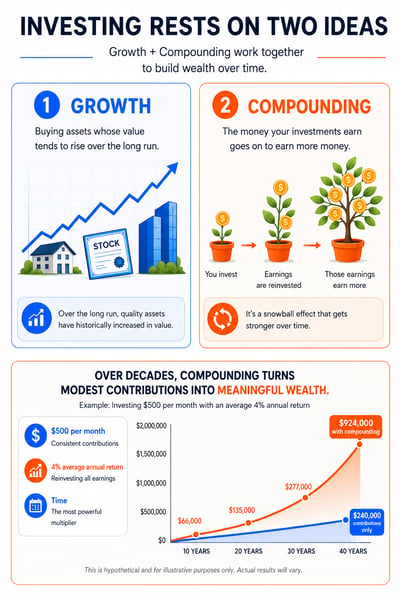
Investing rests on two ideas: growth (buying assets whose value tends to rise over the long run) and compounding (the money your investments earn goes on to earn more money). Over decades, compounding turns modest contributions into meaningful wealth.
Most Canadians invest through a handful of common products:
As of January 2026, Canadian investment firms must show the total cost of owning their investments in dollar terms, thanks to new total cost reporting rules. Even a 1% difference in fees can cost tens of thousands of dollars over 20 or 30 years.
The main advantage of investing is long-term growth. The S&P/TSX Composite has averaged roughly 8.8% compound annual growth over the five years leading into 2026, enough to outpace inflation and support long-term goals like retirement.
The drawback is volatility. Markets can drop 10%, 20%, or more in a given year. That's why investing works best with a long runway, ideally five years or more, and only once more urgent priorities like high-interest debt are under control.
Saving and investing aren't competing strategies. They solve different problems. The easiest way to see the difference is to compare them side by side.
|
Saving |
Investing |
|
|
Main goal |
Protect your money |
Grow your money |
|
Time horizon |
Under three years |
Five years or more |
|
Risk |
Very low |
Moderate to high |
|
Accessibility (liquidity) |
High, available quickly depending on the savings vehicle (eg, GICs or savings accounts). |
Lower, may take days, sometimes with penalties |
|
Typical returns (2026) |
1.5% to 4% |
5% to 9% long-term average |
|
Impact of inflation |
Purchasing power can erode |
Potential to outpace inflation over time |
|
Deposit insurance |
Covered by CDIC up to $100,000 per category |
Not covered by CDIC |
Saving wins on certainty. Investing wins on growth. Which one fits depends entirely on when you need the money and how you'd feel if the balance dropped before you could use it.
The most useful question isn't "Should I save or invest?" It's "When will I need this money?" Money you won't touch for five or more years can be invested. For goals that sit in the three-to-five-year middle zone, a blend often makes sense, such as keeping the portion you're more certain about (like a down payment you plan to use in year four) in a HISA or GIC, while the rest stays invested.
One misconception that Credit Canada Counsellors often hear is that saving and investing are essentially the same thing, just different flavours. They aren't. Saving prioritizes capital preservation and liquidity, whereas investing accepts market volatility in exchange for the potential of long-term growth. Putting down payment money in the stock market or retirement money in a savings account is how some people end up short when they need the cash.
Sometimes neither one is the right fit. If your income is unstable, you have no emergency buffer, or you're carrying high-interest debt growing faster than any investment could reasonably earn, the foundational work should come first.
Personal finance is about directing your money where it works hardest for you. Think of this as a step-by-step progression for building a resilient foundation.
If you're not sure where to start, Credit Canada's AI-powered debt management agent, Mariposa, can help: a free, judgment-free tool for Canadians who feel stuck and want financial advice before talking to someone.
Before you commit to a long-term investment strategy, it is vital to ensure high-interest debt isn't undoing your progress. Our debt assessment help quiz offers a similar starting point to help you understand which debt relief options are best for your situation.
A TFSA, RRSP, or FHSA isn't a product in itself. It's a tax shelter that can hold either savings or investments. What goes inside is up to you.
The account you choose matters, and so does what you put inside it. Each account has different tax rules, contribution limits, and withdrawal conditions, so the goal is to match the right asset with the right account.
For example, an RRSP is a poor fit for a short-term vacation fund because withdrawals are taxed as income; a TFSA is much better suited for that. A TFSA can comfortably hold a HISA for next year's expenses or an investment portfolio for retirement decades away, while an FHSA only makes sense if a first home is in your plans.
The right pairing depends on both your timeline and your tax situation, so it's worth taking the time to match them up before contributing.
Every financial choice has trade-offs, and it’s important to understand the risks associated with each.
A savings account feels safe because the dollar figure never drops, but what that dollar buys can shrink year after year. Mike Bergeron, Counselling Manager at Credit Canada, puts it plainly: "Relying solely on 'safe' savings can carry hidden risk, particularly when the return on a typical savings account (around 1–3% annually at major Canadian institutions) falls below the rising cost of living, with the Consumer Price Index increasing by approximately 2–3% per year on average in Canada."
Savings rates at major Canadian banks are currently running slightly ahead of inflation, though that gap is narrow. Long-term money in a low-yield account tends to lose value over time.
Investing carries the opposite risk. Your money can grow faster, but it can also drop sharply before it recovers. The longer your time horizon, the more room you have to ride out that volatility. If you need the money in under three years, even a "safe" balanced portfolio can end up worth less than you put in.
“There's a third risk people miss: trying to save or invest while carrying high-interest debt. The interest rates on common consumer debt almost always outrun what markets can realistically deliver: "Carrying high-interest debt, such as credit cards, can undermine the benefits of investing, as the average interest rate on credit cards in Canada is around 19–21%, while a typical long-term investment portfolio may generate returns of approximately 5–7% annually," Bergeron says.
If you're paying 20% on a credit card and earning 7% in the market, you're effectively losing 13% a year on money that could have been paying down the debt. Clearing high-interest debt delivers a guaranteed, tax-free, and risk-free return of 20%—something no stock market investment can promise.
Not sure how to split your next $100 between a credit card bill and a TFSA? See our guide on balancing debt repayment with saving for a step-by-step priority list.
Before investing seriously, most people need a financial foundation in place. That doesn't mean being wealthy. It means having enough stability that one unexpected expense doesn't send you spiralling back into debt.
Start smaller than you think. Saving $25 a week adds up to $1,300 a year. Automating transfers on payday makes it much easier to stay consistent without having to think twice.
A useful rule of thumb is the 50/15/5 approach: roughly 50% of take-home pay to essentials (housing, food, transport, debt payments), 15% to retirement savings, 5% to short-term savings, and the remaining 30% to life and discretionary spending.
If you’re in a city like Toronto or Vancouver where housing eats up 60% of your budget, don't get discouraged. The 50/15/5 rule is a target, not a prerequisite. In high-cost areas, focus on the $25-a-week habit first. When you’re just starting, the consistency of the habit matters much more than the percentage of the cheque.
If you have credit card debt, make an effort to bring your credit utilization to less than 30% before starting to invest. Aiming for 30% utilization is a double win: it reduces the interest you pay while signalling to lenders that you're a responsible borrower. This helps improve your credit score for future goals like a mortgage.
You don't have to choose between paying off debt and saving, and trying to do only one can actually backfire. As Bergeron explains, it's a question of sequencing: "It's always good to save, but if you're carrying a fair amount of debt, your money may be better used to pay it down first. High-interest debts like credit cards at 19.99%–24.99% or lines of credit at 8%–12% accrue interest faster than typical investments grow."
A practical approach might be to keep a small emergency fund ($500 to $1,000) while aggressively paying down your highest-interest balance. That way, a surprise car repair doesn't send you back to the credit card.
The same logic applies in reverse when weighing whether to move savings into investments. Bergeron cautions against touching your emergency fund without a clear framework for what needs to stay liquid.
“Before reallocating emergency savings into long-term investment vehicles, Canadians should carefully assess their financial goals and the proportion of funds being considered for investment,” he advises. “A structured evaluation of short-, medium-, and long-term objectives provides a clear framework for determining how much capital should remain readily accessible for unforeseen needs, and how much may be prudently allocated toward long-term growth opportunities."
A useful milestone to watch for is when your credit utilization (the percentage of your total credit limit you're actively using) drops below 30%. Reaching that mark is often a sign that your debt has become manageable enough to start fuelling longer-term goals. From there, you can begin saving and investing more meaningfully while you finish paying off what's left.
If minimum payments are eating most of what you could otherwise save, consolidation may be worth considering. Credit Canada's Debt Consolidation Program (a DCP, also known as a Debt Management Program) combines unsecured debts into one affordable monthly payment, often at a significantly reduced or zero interest rate, with no risk to assets like your home.
By lowering your interest rates to near zero, a DCP reduces your monthly obligations, effectively 'freeing up' the cash you need to finally build that emergency fund or start your TFSA.
The saving vs. investing question mostly comes down to time. Under three years? Saving keeps it safe and accessible. Five or more? Investing gives it room to grow and outpace inflation. In between? A blend often works best.
But before either question really matters, your financial foundation needs to be in place. For many Canadians in 2026, that means tackling high-interest debt before anything else. A stock market return can't consistently outrun a 20% credit card balance, and no savings rate can either.
If your situation feels more complicated than a blog post can untangle, our team can help. The Credit Canada GOLD financial coaching program is one option. It includes six weeks of two-hour group sessions, small group coaching, a supportive community, and accountability buddies. Since Credit Canada GOLD’s inception, participants have collectively paid off more than $4 million in debt, averaging $11,934 per person.
You can also connect with a certified Credit Counsellor at 1 (800) 262-2272 at no cost for guidance that’s always confidential and tailored to your unique financial situation. If you want to explore your options at your own pace and schedule, you can chat with Mariposa, our AI-powered debt management agent, for personalized advice when it’s most convenient for you.